
Panasonic LUMIX S1 Full Frame Photography Camera
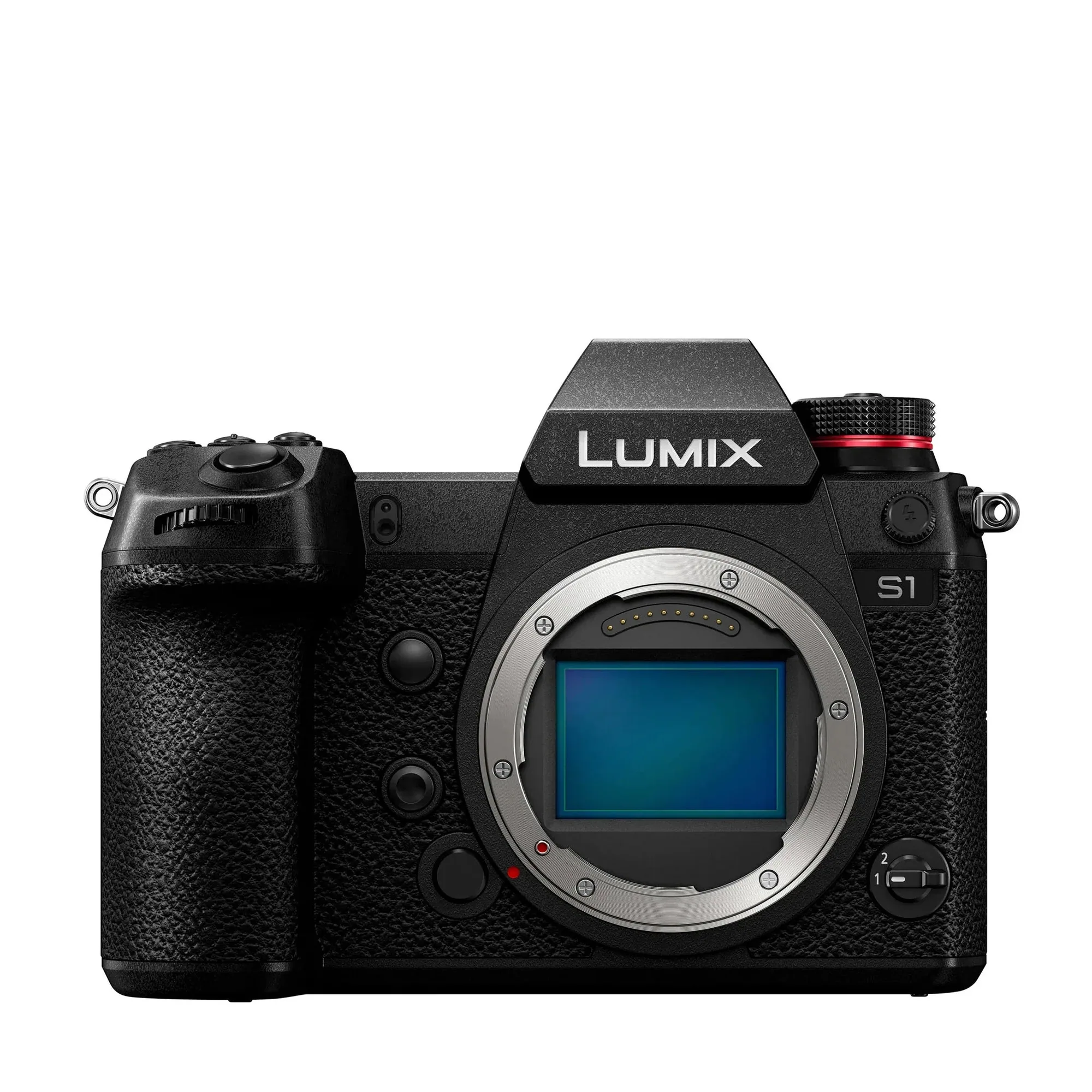
Panasonic · LUMIX S1
$2,499.99 MSRP
Key Features
- Full Frame CMOS
- 5-Axis In-Body Stabilization
- Subject Detection
- Up to 9 fps Continuous Shooting
- Up to 180 fps Video
- L-Mount
🔒 Log in to add this to a kit.
In the Box
- 1 × Panasonic DMW-BLJ31 Rechargeable Lithium Ion Battery
- 1 × AC Adaptor
- 1 × AC Mains Lead
- 1 × Battery Charger
- 1 × Battery Grip Connector Cover
- 1 × Body Cap
- 1 × Cable Holder
- 1 × Eye Cup
- 1 × Flash Sync Socket Cap
- 1 × Hot Shoe Cover
- 1 × Shoulder Strap
- 1 × USB Cable (Type A to Type C)
- 1 × USB-C to USB-C Cable
Colorist
Professional Color Profiles2
HLG / Rec.2020
Industry Standard10 stops10-bit recommendedHDRBroadcastQuick TurnaroundStreaming DeliveryHybrid Log-Gamma on the BT.2020 container, the pairing ITU-R BT.2100 defines for broadcast HDR. HLG is scene-referred and display-independent, so a single signal renders acceptably on both SDR and HDR displays without a separate SDR master — which is why it is the usual choice for live work where the viewer's display cannot be assumed. This is the standard HLG pairing; the BT.709-container variant exists because some cameras allow the narrower container with the same curve.
Curve: HLG2015
Hybrid Log-Gamma, developed jointly by the BBC and NHK and standardized in ITU-R BT.2100. It follows a conventional gamma curve through shadows and midtones and switches to logarithmic encoding only in the highlights, which is where the name comes from. That hybrid shape is what lets a single signal render acceptably on both SDR and HDR displays without a separate SDR master. It is scene-referred and display-independent, unlike PQ, which makes it the practical choice for live broadcast where the viewer's display cannot be assumed.
Gamut: Rec.2020Industry Standard · 2012
Defined in ITU-R BT.2020 in 2012 for ultra-high-definition television; BT.2100 later reused the same primaries for HDR. All three primaries sit on the spectral locus — they are monochromatic — which makes it the widest gamut definable without imaginary coordinates, covering 1.89 times the area of Rec.709. It is a delivery container rather than a capture space. No current display reproduces it in full, so HDR work is typically monitored on a P3 subset and delivered inside a 2020 container.
LUTs & References1
Panasonic V-LOG / V-Gamut (Paid Firmware Update)
Manufacturer Default14 stops10-bit recommendedHDRCinemaHybrid Photo/VideoThe same pairing as the standard V-Log profile, unlocked by a paid Panasonic firmware upgrade rather than shipped enabled. It appears on hybrid bodies that did not carry V-Log from the factory, including the original GH4. Once installed the recording behavior is identical to the standard pairing, so material from an upgraded body and a natively equipped one grade through the same path.
Curve: V-LOG2014
Introduced with Varicam in 2014 and carried onto the EVA1 and the cinema-capable S-series, paired with V-Gamut. It places 18% gray at 0.4233 — 42% IRE, the figure Panasonic states — with 8.0 stops of headroom above it. Its shadow region sits higher than most curves here, at 0.1407 six stops below gray. That lift keeps shadow detail clear of the bottom of the code range in 10-bit recording, at the cost of a flatter image before grading.
Gamut: V-GamutProprietary · 2014
Introduced with V-Log for Varicam, and carried onto the EVA1 and the cinema-capable S-series. It covers 2.36 times Rec.709, which places it above Rec.2020 by a quarter and above DCI-P3 by three quarters; only its blue primary is imaginary, at y = -0.030. It was sized to contain the common delivery targets rather than to maximize area. The practical consequence is that one capture can be graded to Rec.709, P3 or Rec.2020 without running out of gamut on the way.
LUTs & References4
Picture Profiles12
- Panasonic Cinelike DCinematic
Provides a flatter color profile with reduced contrast, ideal for color grading in post-production while retaining a film-like quality.
- Panasonic Cinelike VCinematic
A film-like Photo Style whose gamma curve gives priority to contrast. Offered on the GH5S and S1; later bodies carry its successor, Cinelike V2.
- Panasonic FlatCinematic
Offers a flat color profile with low contrast and saturation, allowing for more flexibility in post-production color grading.
- Panasonic Like709Cinematic
A Photo Style applying a gamma correction equivalent to Rec.709, compressing high-luminance areas through an adjustable knee to minimize overexposure. Intended for material delivered without grading.
- Panasonic LandscapeLandscape
A Photo Style suited to scenery, with vivid blue skies and greens. Panasonic used the name [Scenery] on earlier bodies such as the GH5S.
- Panasonic L.MonochromeMonochrome
Offers a softer monochrome effect with lower contrast for a more subtle, muted black-and-white appearance.
- Panasonic L.Monochrome DMonochrome
A monochrome Photo Style with enhanced highlights and shadows for a dynamic impression, sitting between L.Monochrome and a fully graded black-and-white look.
- Panasonic MonochromeMonochrome
A clean black-and-white profile with no toning. Provides a classic, timeless monochrome rendering with full contrast control via the camera's tone settings.
- Panasonic NaturalNatural
A more subdued, neutral profile with reduced contrast and saturation. Renders subjects closer to their real-world appearance and leaves more grading room than Standard.
- Panasonic StandardNatural
Panasonic's all-purpose default. Balanced contrast and saturation suitable for general shooting across portraits, landscapes, and everyday situations.
- Panasonic PortraitPortrait
Optimizes color and contrast to enhance skin tones and provide a pleasing look for portraits.
- Panasonic VividVivid
Boosts contrast and saturation for richer, more vibrant images. Good for travel, landscapes, and any subject where bold color helps the image.