
Panasonic LUMIX S1R II Full Frame Photography Camera
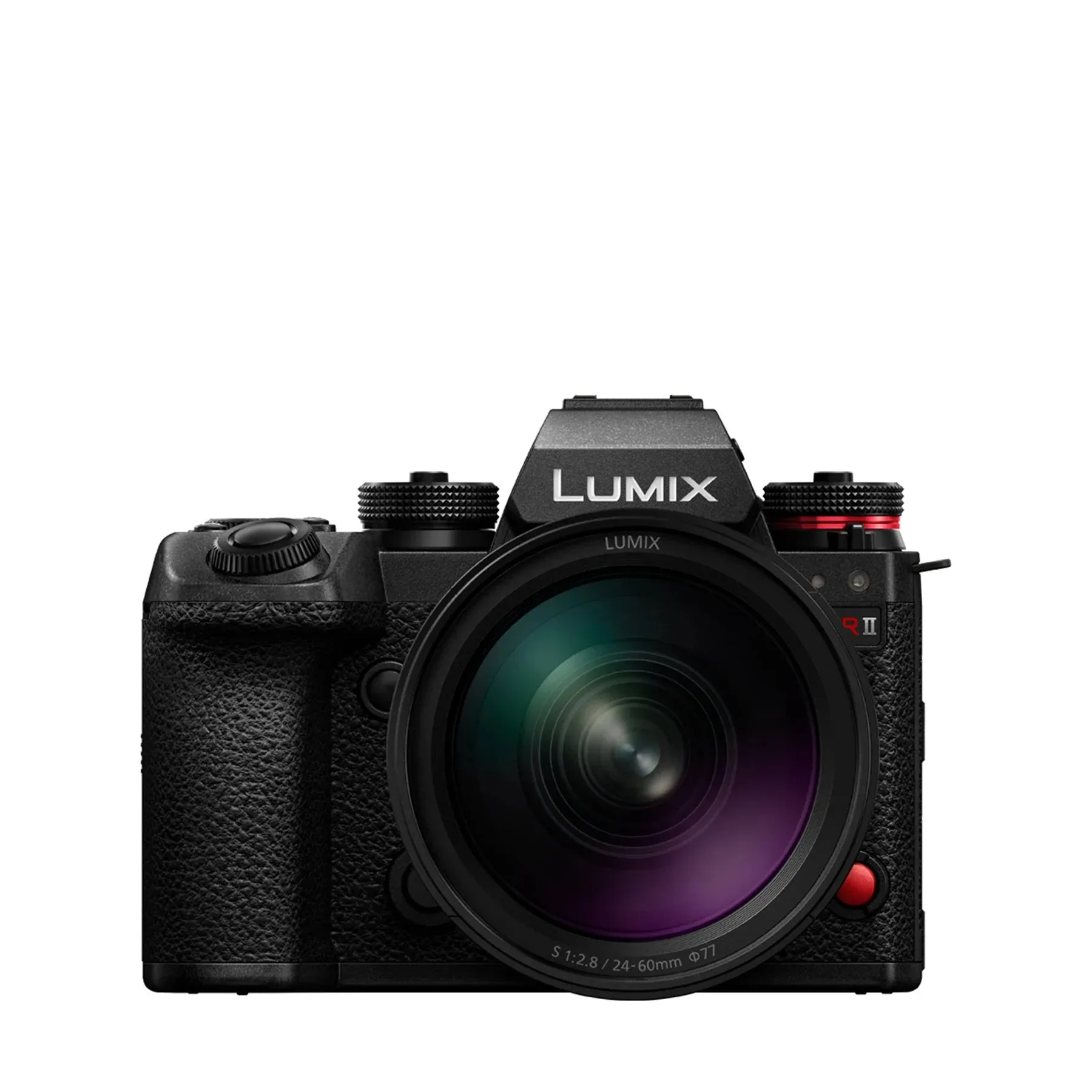
Panasonic · LUMIX S1
$3,299.00 MSRP
Key Features
- Full Frame BSI CMOS
- 5-Axis In-Body Stabilization
- Subject Detection
- Up to 40 fps Continuous Shooting
- Up to 120 fps Video
- L-Mount
🔒 Log in to add this to a kit.
In the Box
- 1 × DMW-BLK22 Battery Pack
- 1 × Battery Charger
- 1 × Battery Grip Connector Cover
- 1 × Body Cap
- 1 × Hot Shoe Cover
- 1 × Shoulder Strap
Colorist
Professional Color Profiles2
Panasonic LOGC3 / Wide Gamut (Paid Firmware Update)
ARRI ALEV14 stops10-bit recommendedHDRCinemaTheatrical DeliveryARRI's LogC3 pairing made available on certain Panasonic bodies through a paid firmware upgrade — a manufacturer licensing another's color science rather than a Panasonic space. Once installed, the camera records ARRI's classic pairing and the material linearizes as ALEXA footage does, carrying the same exposure-index dependence that LogC3 has on ARRI bodies.
Curve: LOGC32010
Introduced with the original ALEXA in 2010 and used across the ALEXA Classic, AMIRA, ALEXA Mini and SXT, paired with ARRI Wide Gamut. Unlike its successor it is exposure-index dependent: ARRI publishes a separate parameter set for every EI the camera offers and recommends the EI 800 set where a single one has to stand in. At EI 800 it places 18% gray at 0.3910 with 8.3 stops of headroom above it. That EI dependence is the operational catch — linearizing with the wrong parameter set shifts the entire curve, so the rating the camera was set to has to travel with the footage.
Gamut: Wide GamutProprietary · 2010
Introduced as ALEXA Wide Gamut RGB with the original ALEXA in 2010 and paired with LogC3, covering the ALEXA Classic, AMIRA, ALEXA Mini and SXT. At 2.28 times Rec.709 it is deliberately modest for a capture space, and only its blue primary is imaginary at y = -0.102. That restraint is the design point rather than a limitation: the space stays close enough to realisable color that material holds together under a light grade, which accounts for much of why the ALEXA image became a reference.
LUTs & References13
- ALEXA SXT Look Management White PaperPDF
- AMIRA & ALEXA Mini - Color by NumbersPDF
- ARRI Dynamic Range White PaperPDF
- ARRI LogC3 SpecificationPDF
- ARRI Look Library LogC3 (3D-LUTs)Web ↗
- ARRI LUT GeneratorWeb ↗
- ARRI Technical Downloads — LUT Packages and Look LibrariesWeb ↗
- Color Workflows for Mixing ARRI LogC3 and LogC4 (with Sample Projects)PDF
- How to create an ARRI Look File 4 - Workflow GuidelinePDF
- How to set up Pomfort Livegrade for ARRI CamerasPDF
- LUT Naming Convention LogC4 and LogC3 - GuidelinePDF
- Mixing ARRI LogC3 and LogC4 On Set - GuidelinePDF
- Rendering Dailies in DaVinci Resolve - Workflow GuidelinePDF
Panasonic V-LOG / V-Gamut
Manufacturer Default14 stops10-bit recommendedHDRCinemaStreaming DeliveryTheatrical DeliveryPanasonic's standard cinema pairing, introduced with Varicam and carried onto the EVA1 and the cinema-capable S-series. Its container was sized to hold the common delivery targets rather than to maximize area, so one capture can be graded to Rec.709, DCI-P3 or Rec.2020 without running out of gamut on the way. The curve places mid gray at 42% IRE, the figure Panasonic states.
Curve: V-LOG2014
Introduced with Varicam in 2014 and carried onto the EVA1 and the cinema-capable S-series, paired with V-Gamut. It places 18% gray at 0.4233 — 42% IRE, the figure Panasonic states — with 8.0 stops of headroom above it. Its shadow region sits higher than most curves here, at 0.1407 six stops below gray. That lift keeps shadow detail clear of the bottom of the code range in 10-bit recording, at the cost of a flatter image before grading.
Gamut: V-GamutProprietary · 2014
Introduced with V-Log for Varicam, and carried onto the EVA1 and the cinema-capable S-series. It covers 2.36 times Rec.709, which places it above Rec.2020 by a quarter and above DCI-P3 by three quarters; only its blue primary is imaginary, at y = -0.030. It was sized to contain the common delivery targets rather than to maximize area. The practical consequence is that one capture can be graded to Rec.709, P3 or Rec.2020 without running out of gamut on the way.
LUTs & References4
Picture Profiles16
- Panasonic Cinelike A2Cinematic
A film-like Photo Style introduced on the S1 II and S1R II, joining Cinelike D2 and Cinelike V2 as a third in-camera cinema gamma.
- Panasonic Cinelike D2Cinematic
A film-like Photo Style whose gamma curve gives priority to dynamic range, intended for footage that will be edited and graded. The successor to Cinelike D on bodies from the GH6 and S1H generation onward.
- Panasonic Cinelike V2Cinematic
Offers increased contrast and saturation for a more vivid, cinematic look while still maintaining some flexibility for post-production adjustments.
- Panasonic FlatCinematic
Offers a flat color profile with low contrast and saturation, allowing for more flexibility in post-production color grading.
- Panasonic Like709Cinematic
A Photo Style applying a gamma correction equivalent to Rec.709, compressing high-luminance areas through an adjustable knee to minimize overexposure. Intended for material delivered without grading.
- Panasonic LandscapeLandscape
A Photo Style suited to scenery, with vivid blue skies and greens. Panasonic used the name [Scenery] on earlier bodies such as the GH5S.
- Panasonic L.MonochromeMonochrome
Offers a softer monochrome effect with lower contrast for a more subtle, muted black-and-white appearance.
- Panasonic L.Monochrome DMonochrome
A monochrome Photo Style with enhanced highlights and shadows for a dynamic impression, sitting between L.Monochrome and a fully graded black-and-white look.
- Panasonic L.Monochrome SMonochrome
A monochrome Photo Style with a gentle touch, suited to portraiture where the harder contrast of L.Monochrome D would be unflattering.
- Panasonic LEICA MonochromeMonochrome
A Photo Style realizing Leica’s monochrome rendering, with deep contrast between black and white. Offered on the GH7, S9, S1 II and S1R II.
- Panasonic MonochromeMonochrome
A clean black-and-white profile with no toning. Provides a classic, timeless monochrome rendering with full contrast control via the camera's tone settings.
- Panasonic NaturalNatural
A more subdued, neutral profile with reduced contrast and saturation. Renders subjects closer to their real-world appearance and leaves more grading room than Standard.
- Panasonic StandardNatural
Panasonic's all-purpose default. Balanced contrast and saturation suitable for general shooting across portraits, landscapes, and everyday situations.
- Panasonic PortraitPortrait
Optimizes color and contrast to enhance skin tones and provide a pleasing look for portraits.
- Panasonic L.ClassicNeoVintage / Film
provides a vintage-inspired look with subdued colors and enhanced dynamic range, evoking a nostalgic, film-like quality.
- Panasonic VividVivid
Boosts contrast and saturation for richer, more vibrant images. Good for travel, landscapes, and any subject where bold color helps the image.