
Canon EOS R5 C Full-Frame 8K Hybrid Cinema Camera
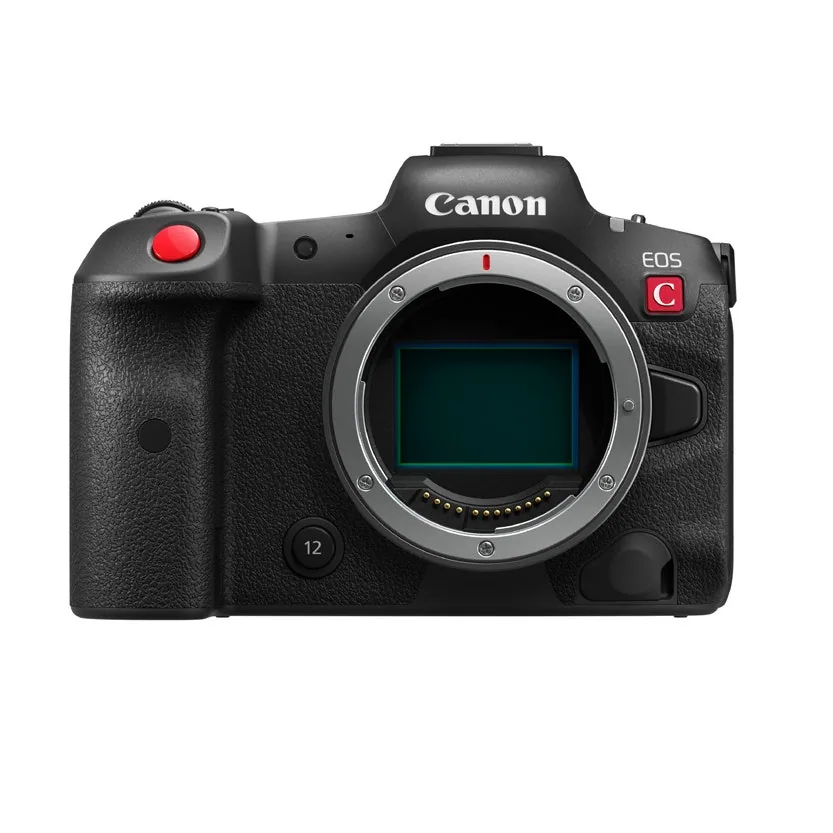
Canon · Canon Cinema EOS
$4,499.00 MSRP
Key Features
- Full Frame CMOS
- RF-Mount
- C-LOG 3
- Up to 60 fps
- Internal Cinema RAW Light
🔒 Log in to add this to a kit.
In the Box
- 1 × Canon LP-E6NH Lithium-Ion Battery (7.2V, 2130mAh)
- 1 × Cable Protector
- 1 × Canon EOS R5 C Mirrorless Cinema Camera
- 1 × Canon IFC-100U Interface Cable (39.4")
- 1 × Canon LC-E6 Charger for LP-E6 and LP-EL Battery Packs
- 1 × Canon R-F-5 Camera Cover
- 1 × SS-1200 Shoulder Strap
Colorist
Professional Color Profiles10
BT.709 Standard / Rec.709
Industry StandardSDRBroadcastQuick TurnaroundThe ITU-R BT.709 transfer characteristic on the BT.709 color space — the high-definition broadcast baseline, for playback on BT.709 monitors without grading. Both halves of the pairing come from the same standard, which is what distinguishes it from the manufacturer renderings that also target BT.709. It reserves no latitude for a grade, being a delivery rendering rather than a capture profile.
Curve: BT.709 Standard
Canon's standard BT.709 gamma, applying the conventional Rec.709 transfer characteristic in camera. It is a finished rendering rather than a capture curve, reserving no latitude for grading, and is offered on Cinema EOS bodies alongside the C-Log family and the other BT.709 variants. It suits broadcast and fast-turnaround delivery, where material goes out with little or no correction applied after the fact.
Gamut: Rec.709Industry Standard · 1990
Defined in ITU-R BT.709 in 1990 to give high-definition television a single colorimetric target as broadcasters moved off analogue standards. Its primaries were chosen to be reproducible on the CRT phosphors of the period, so all three sit inside the spectral locus and every color it defines is physically realisable. It is the smallest space in this base, and the reference every wider gamut here is measured against. In practice it is a delivery target rather than a capture space: grades finish in Rec.709 by default for broadcast, web and any non-HDR delivery.
Canon BT.709 Normal / Rec.2020
Canon Cinema EOS C.S. 2HDRBroadcastQuick TurnaroundThe BT.709 Normal curve paired with the BT.2020 container. Offered on the C70, C300 Mark III, C500 Mark II and R5 C only. The curve is a finished broadcast rendering, so the wider container affects the color space the material is carried in rather than the latitude available to a grade.
Curve: BT.709 Normal
Canon's standard BT.709 rendering, applying conventional Rec.709 contrast in camera. It is the least latitude-preserving of Canon's gamma options and is meant for direct delivery rather than grading. In this base it links to both the Rec.709 and Rec.2020 gamut records, reflecting the color-space options Canon exposes alongside the gamma setting on Cinema EOS bodies.
Gamut: Rec.2020Industry Standard · 2012
Defined in ITU-R BT.2020 in 2012 for ultra-high-definition television; BT.2100 later reused the same primaries for HDR. All three primaries sit on the spectral locus — they are monochromatic — which makes it the widest gamut definable without imaginary coordinates, covering 1.89 times the area of Rec.709. It is a delivery container rather than a capture space. No current display reproduces it in full, so HDR work is typically monitored on a P3 subset and delivered inside a 2020 container.
Canon BT.709 Normal / Rec.709
Canon Cinema EOS C.S. 2SDRBroadcastQuick TurnaroundA conventional broadcast-contrast curve on BT.709. Offered on the C70, C300 Mark III, C500 Mark II and R5 C only. It is the least latitude-preserving of Canon's pairings, intended for direct delivery rather than for grading.
Curve: BT.709 Normal
Canon's standard BT.709 rendering, applying conventional Rec.709 contrast in camera. It is the least latitude-preserving of Canon's gamma options and is meant for direct delivery rather than grading. In this base it links to both the Rec.709 and Rec.2020 gamut records, reflecting the color-space options Canon exposes alongside the gamma setting on Cinema EOS bodies.
Gamut: Rec.709Industry Standard · 1990
Defined in ITU-R BT.709 in 1990 to give high-definition television a single colorimetric target as broadcasters moved off analogue standards. Its primaries were chosen to be reproducible on the CRT phosphors of the period, so all three sit inside the spectral locus and every color it defines is physically realisable. It is the smallest space in this base, and the reference every wider gamut here is measured against. In practice it is a delivery target rather than a capture space: grades finish in Rec.709 by default for broadcast, web and any non-HDR delivery.
Canon BT.709 Wide DR / Rec.2020
Canon Cinema EOS C.S. 2HDRBroadcastQuick TurnaroundThe Wide DR curve paired with the wider BT.2020 container. Offered on the C70, C300 Mark III, C500 Mark II and R5 C, and absent from the C50 / C80 / C400 generation. It extends the Wide DR compromise to an HDR container: broadcast-compatible contrast, with a color space sized for HDR delivery rather than HD.
Curve: BT.709 Wide DR
Canon's Wide DR gamma, which extends dynamic range beyond a standard BT.709 rendering while keeping a broadcast-compatible contrast curve. It occupies the middle ground between Canon's finished BT.709 renderings and the C-Log family: more latitude than the former, far less grading required than the latter. Like BT.709 Normal it links here to both Rec.709 and Rec.2020, reflecting the gamut options Canon pairs with it.
Gamut: Rec.2020Industry Standard · 2012
Defined in ITU-R BT.2020 in 2012 for ultra-high-definition television; BT.2100 later reused the same primaries for HDR. All three primaries sit on the spectral locus — they are monochromatic — which makes it the widest gamut definable without imaginary coordinates, covering 1.89 times the area of Rec.709. It is a delivery container rather than a capture space. No current display reproduces it in full, so HDR work is typically monitored on a P3 subset and delivered inside a 2020 container.
Canon BT.709 Wide DR / Rec.709
Canon Cinema EOS C.S. 2SDRBroadcastQuick TurnaroundDocumentaryA very wide dynamic range on a BT.709 container, optimized for playback on BT.709 monitors. Canon's predecessor to Canon 709; it remains the basis of the EOS Standard and EOS Neutral presets on the Cinema line. It occupies the middle ground between Canon's finished BT.709 renderings and the C-Log family — more latitude than the former, far less grading than the latter.
Curve: BT.709 Wide DR
Canon's Wide DR gamma, which extends dynamic range beyond a standard BT.709 rendering while keeping a broadcast-compatible contrast curve. It occupies the middle ground between Canon's finished BT.709 renderings and the C-Log family: more latitude than the former, far less grading required than the latter. Like BT.709 Normal it links here to both Rec.709 and Rec.2020, reflecting the gamut options Canon pairs with it.
Gamut: Rec.709Industry Standard · 1990
Defined in ITU-R BT.709 in 1990 to give high-definition television a single colorimetric target as broadcasters moved off analogue standards. Its primaries were chosen to be reproducible on the CRT phosphors of the period, so all three sit inside the spectral locus and every color it defines is physically realisable. It is the smallest space in this base, and the reference every wider gamut here is measured against. In practice it is a delivery target rather than a capture space: grades finish in Rec.709 by default for broadcast, web and any non-HDR delivery.
Canon C-LOG 3 / Cinema Gamut
Canon Cinema EOS C.S. 212 stops10-bit recommendedHDRCinemaStreaming DeliveryC-Log 3 in Canon's widest container, from the second generation of Cinema EOS color science. Canon positions C-Log 3 as the successor to C-Log rather than to C-Log 2, so this pairing offers Cinema Gamut's room with a curve that needs less grading to resolve than the C-Log 2 equivalent. It is the middle option of the Canon range: more container and more latitude than the Rec.709 pairing, less flattening than C-Log 2 / Cinema Gamut.
Curve: C-LOG 32018
Added to the EOS C300 Mark II by firmware and now offered across the Cinema EOS range. Canon states it succeeds C-Log rather than C-Log 2, keeping C-Log's shadow and mid-gray behavior while extending range by about one stop — and the published curves bear that out exactly: both place 18% gray at 0.3434, while headroom rises from 5.4 stops to 6.3. That combination is the design intent, C-Log's ease of grading with a stop more room above middle gray.
Gamut: Cinema GamutProprietary · 2014
Canon's widest capture space, introduced with the Cinema EOS line to hold everything the sensor records. At 3.50 times Rec.709 and 1.85 times Rec.2020 it is the third widest gamut in this base; its green primary has a y coordinate above 1 and its blue y is negative, so a large part of it is imaginary. Canon recommends it with C-Log 2 for ACES workflows. It is a container rather than a look, and is normally converted into a working space before any creative grading begins.
LUTs & References4
Canon C-LOG 3 / Rec.2020
Canon Cinema EOS C.S. 212 stops10-bit recommendedHDRStreaming DeliveryHybrid Photo/VideoC-Log 3 on the BT.2020 container, from the second generation of Cinema EOS color science. BT.2020 is the standard delivery container for HDR, so this pairing matches a gradeable curve to the space the deliverable will be carried in. It is the HDR-delivery member of the C-Log 3 set, where the Rec.709 pairing targets SDR and the Cinema Gamut pairing keeps the widest capture container.
Curve: C-LOG 32018
Added to the EOS C300 Mark II by firmware and now offered across the Cinema EOS range. Canon states it succeeds C-Log rather than C-Log 2, keeping C-Log's shadow and mid-gray behavior while extending range by about one stop — and the published curves bear that out exactly: both place 18% gray at 0.3434, while headroom rises from 5.4 stops to 6.3. That combination is the design intent, C-Log's ease of grading with a stop more room above middle gray.
Gamut: Rec.2020Industry Standard · 2012
Defined in ITU-R BT.2020 in 2012 for ultra-high-definition television; BT.2100 later reused the same primaries for HDR. All three primaries sit on the spectral locus — they are monochromatic — which makes it the widest gamut definable without imaginary coordinates, covering 1.89 times the area of Rec.709. It is a delivery container rather than a capture space. No current display reproduces it in full, so HDR work is typically monitored on a P3 subset and delivered inside a 2020 container.
LUTs & References4
Canon C-LOG 3 / Rec.709
Canon Cinema EOS C.S. 212 stops10-bit recommendedSDRQuick TurnaroundDocumentaryHybrid Photo/VideoC-Log 3 on the BT.709 container, from the second generation of Cinema EOS color science. The pairing keeps a log curve's shadow and highlight latitude while staying inside the delivery space, so material needs no gamut conversion on the way to an HD master. It is the fastest of the C-Log 3 pairings to finish, and the narrowest — the Cinema Gamut and BT.2020 options trade that directness for room.
Curve: C-LOG 32018
Added to the EOS C300 Mark II by firmware and now offered across the Cinema EOS range. Canon states it succeeds C-Log rather than C-Log 2, keeping C-Log's shadow and mid-gray behavior while extending range by about one stop — and the published curves bear that out exactly: both place 18% gray at 0.3434, while headroom rises from 5.4 stops to 6.3. That combination is the design intent, C-Log's ease of grading with a stop more room above middle gray.
Gamut: Rec.709Industry Standard · 1990
Defined in ITU-R BT.709 in 1990 to give high-definition television a single colorimetric target as broadcasters moved off analogue standards. Its primaries were chosen to be reproducible on the CRT phosphors of the period, so all three sit inside the spectral locus and every color it defines is physically realisable. It is the smallest space in this base, and the reference every wider gamut here is measured against. In practice it is a delivery target rather than a capture space: grades finish in Rec.709 by default for broadcast, web and any non-HDR delivery.
LUTs & References4
HLG / Rec.2020
Industry Standard10 stops10-bit recommendedHDRBroadcastQuick TurnaroundStreaming DeliveryHybrid Log-Gamma on the BT.2020 container, the pairing ITU-R BT.2100 defines for broadcast HDR. HLG is scene-referred and display-independent, so a single signal renders acceptably on both SDR and HDR displays without a separate SDR master — which is why it is the usual choice for live work where the viewer's display cannot be assumed. This is the standard HLG pairing; the BT.709-container variant exists because some cameras allow the narrower container with the same curve.
Curve: HLG2015
Hybrid Log-Gamma, developed jointly by the BBC and NHK and standardized in ITU-R BT.2100. It follows a conventional gamma curve through shadows and midtones and switches to logarithmic encoding only in the highlights, which is where the name comes from. That hybrid shape is what lets a single signal render acceptably on both SDR and HDR displays without a separate SDR master. It is scene-referred and display-independent, unlike PQ, which makes it the practical choice for live broadcast where the viewer's display cannot be assumed.
Gamut: Rec.2020Industry Standard · 2012
Defined in ITU-R BT.2020 in 2012 for ultra-high-definition television; BT.2100 later reused the same primaries for HDR. All three primaries sit on the spectral locus — they are monochromatic — which makes it the widest gamut definable without imaginary coordinates, covering 1.89 times the area of Rec.709. It is a delivery container rather than a capture space. No current display reproduces it in full, so HDR work is typically monitored on a P3 subset and delivered inside a 2020 container.
LUTs & References1
PQ / Rec.2020
Industry StandardHDRStreaming DeliveryBroadcastThe ITU-R BT.2100 perceptual-quantizer HDR curve on BT.2020. An industry standard rather than a manufacturer look; Canon exposes it as the PQ preset, and other makers offer the same curve. Unlike HLG it is display-referred and absolute — a code value specifies a luminance in nits rather than a relative exposure — so PQ material is graded against a mastering display of known peak luminance, and that metadata travels with the deliverable.
Curve: PQ
Perceptual Quantizer, standardized as SMPTE ST 2084 and carried into ITU-R BT.2100. Unlike every log curve in this table it is display-referred and absolute: a code value specifies a particular luminance in nits, up to 10,000, rather than a relative exposure. Its shape follows the contrast sensitivity of human vision, so code values are distributed where the eye can distinguish them. Because it is absolute, PQ material is graded against a mastering display of known peak luminance, and that mastering metadata travels with the deliverable.
Gamut: Rec.2020Industry Standard · 2012
Defined in ITU-R BT.2020 in 2012 for ultra-high-definition television; BT.2100 later reused the same primaries for HDR. All three primaries sit on the spectral locus — they are monochromatic — which makes it the widest gamut definable without imaginary coordinates, covering 1.89 times the area of Rec.709. It is a delivery container rather than a capture space. No current display reproduces it in full, so HDR work is typically monitored on a P3 subset and delivered inside a 2020 container.
Picture Profiles8
- Canon NeutralCinematic
Lower contrast and toned-down saturation produce a flatter, more natural-looking image. Designed to give the most flexibility for color grading and correction in post.
- Canon LandscapeLandscape
Emphasizes blues and greens with added sharpness for vivid, detailed outdoor scenes. Good for landscapes, nature, and any subject where vibrant color helps the image.
- Canon MonochromeMonochrome
Black-and-white rendering with optional in-camera filter effects (yellow, orange, red, green) and toning. A flexible starting point for classic and creative monochrome work.
- Canon AutoNatural
Analyzes the scene and adjusts color, contrast, and sharpness automatically. Skin tones render naturally and well-saturated subjects (skies, foliage) come out vivid — a smart default when you don't want to commit to a specific style.
- Canon FaithfulNatural
Renders subject color accurately as it would appear under D55 daylight (5200K). Best when faithful color reproduction matters — product, archival, fine-art repro — rather than a stylized look.
- Canon Fine DetailNatural
Prioritizes the rendering of subject contour and fine texture over color punch. Designed for highly detailed subjects — architecture, products, intricate patterns — where you want every line and texture to carry through.
- Canon StandardNatural
Canon's general-purpose default. Clear, lively color with stronger contrast and sharpening than the more neutral profiles — designed to look great straight out of camera with minimal editing.
- Canon PortraitPortrait
Smooths skin texture and warms color rendering slightly for flattering, gentle portraits. Reduced sharpening helps faces look more natural without softening the eyes.