
Fujifilm GFX100S II Medium Format Photography Camera
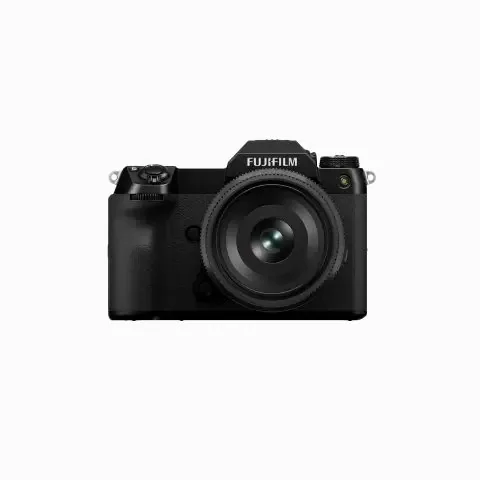
Fujifilm · GFX 100
$4,999.00 MSRP
Key Features
- Medium Format CMOS II
- 5-Axis In-Body Stabilization
- Subject Detection
- Up to 7 fps Continuous Shooting
- Up to 59.94 fps Video
- Fujifilm G-Mount
🔒 Log in to add this to a kit.
In the Box
- 1 × NP-W235 Li-ion Battery
- 1 × AC-5VJ AC Power Adapter
- 1 × Body Cap
- 1 × Cable Protector
- 1 × Hot Shoe Cover
- 1 × Memory Card Slot Cover
- 1 × Plug Adapter
- 1 × Shoulder Strap
- 1 × USB Cable
Colorist
Professional Color Profiles3
Fujifilm F-LOG / F-Gamut
Manufacturer Default13 stops10-bit recommendedHDRCinemaHybrid Photo/VideoStreaming DeliveryFujifilm's standard cinema pairing on the X- and GFX-series video bodies. Because Fujifilm defines F-Gamut as ITU-R BT.2020 outright, this pairing carries a standard container under a manufacturer name — no Fujifilm-specific gamut transform is required, and linearizing the F-Log curve is the whole of the conversion. It places mid gray higher than any other curve in this base, which protects shadows and leaves comparatively little room above middle gray.
Curve: F-LOG2018
Fujifilm's first log curve, introduced with the X-T3 generation in 2018 and paired with F-Gamut, which Fujifilm defines as ITU-R BT.2020. It places 18% gray at 0.4593, the highest of any curve in this base, leaving only 5.3 stops of encoding above mid gray. That is the trade behind its 13 stops of curve latitude: more of the code range is spent below middle gray than above it, so shadows are well protected and highlight room runs out sooner than on F-Log2.
Gamut: F-GamutProprietary · 2018
Introduced with F-Log for the X-series and later the GFX line. Fujifilm defines it as ITU-R BT.2020 outright — the F-Log data sheet states the compliance — so its primaries are identical to the Rec.2020 record in this base and every one of them is realisable. Being a standard rather than a proprietary space simplifies the grade: no manufacturer-specific gamut transform is required, and only the F-Log curve has to be linearized.
LUTs & References2
Fujifilm F-LOG 2 / F-Gamut
Manufacturer Default14 stops10-bit recommendedHDRCinemaStreaming DeliveryHybrid Photo/VideoFujifilm's higher-latitude pairing, introduced with the X-H2 and X-H2S generation. It keeps the BT.2020 container of the F-Log pairing and changes the curve: F-Log2 moves mid gray down, which is what buys the extra range over F-Log. Material from the two pairings therefore shares a container and differs only in the curve to be linearized.
Curve: F-LOG 22022
Introduced with the X-H2 and X-H2S generation in 2022 as a higher-latitude alternative to F-Log. It moves 18% gray down from F-Log's 0.4593 to 0.3910, and that shift is what buys the extra range: headroom rises from 5.3 stops to 8.3. The F-Log2 C variant on the GFX ETERNA uses this identical transfer function and differs only in gamut, so the two share a single linearization step in post.
Gamut: F-GamutProprietary · 2018
Introduced with F-Log for the X-series and later the GFX line. Fujifilm defines it as ITU-R BT.2020 outright — the F-Log data sheet states the compliance — so its primaries are identical to the Rec.2020 record in this base and every one of them is realisable. Being a standard rather than a proprietary space simplifies the grade: no manufacturer-specific gamut transform is required, and only the F-Log curve has to be linearized.
LUTs & References3
HLG / Rec.2020
Industry Standard10 stops10-bit recommendedHDRBroadcastQuick TurnaroundStreaming DeliveryHybrid Log-Gamma on the BT.2020 container, the pairing ITU-R BT.2100 defines for broadcast HDR. HLG is scene-referred and display-independent, so a single signal renders acceptably on both SDR and HDR displays without a separate SDR master — which is why it is the usual choice for live work where the viewer's display cannot be assumed. This is the standard HLG pairing; the BT.709-container variant exists because some cameras allow the narrower container with the same curve.
Curve: HLG2015
Hybrid Log-Gamma, developed jointly by the BBC and NHK and standardized in ITU-R BT.2100. It follows a conventional gamma curve through shadows and midtones and switches to logarithmic encoding only in the highlights, which is where the name comes from. That hybrid shape is what lets a single signal render acceptably on both SDR and HDR displays without a separate SDR master. It is scene-referred and display-independent, unlike PQ, which makes it the practical choice for live broadcast where the viewer's display cannot be assumed.
Gamut: Rec.2020Industry Standard · 2012
Defined in ITU-R BT.2020 in 2012 for ultra-high-definition television; BT.2100 later reused the same primaries for HDR. All three primaries sit on the spectral locus — they are monochromatic — which makes it the widest gamut definable without imaginary coordinates, covering 1.89 times the area of Rec.709. It is a delivery container rather than a capture space. No current display reproduces it in full, so HDR work is typically monitored on a P3 subset and delivered inside a 2020 container.
LUTs & References1
Picture Profiles14
- Fujifilm EternaCinematic
Cinematic simulation with low contrast and subdued colors. Designed for video and narrative work, leaving room for color grading.
- Fujifilm Eterna Bleach BypassCinematic
High-contrast, desaturated look that mimics the bleach bypass film process. Creates a moody, dramatic, and stylized atmosphere.
- Fujifilm Acros (Monochrome)Monochrome
Rich black-and-white simulation with fine detail and film-like grain. Available with Yellow, Red, and Green filter options for tonal control.
- Fujifilm MonochromeMonochrome
Classic black-and-white rendering with less tonal complexity than Acros. Available with Yellow, Red, and Green filter variations.
- Fujifilm Provia / StandardNatural
Balanced and true-to-life color rendering, designed to be a versatile all-purpose option. Works well across portraits, landscapes, and general photography.
- Fujifilm Reala AceNatural
Balances natural colors with slightly enhanced saturation and contrast. Designed as a versatile film sim that sits between Provia and Classic Chrome.
- Fujifilm Astia / SoftPortrait
Softens contrast and saturation for natural skin tones and gentle color. A favorite for fashion, portraits, and softer scenes.
- Fujifilm Pro Neg. HiPortrait
Offers slightly higher contrast while keeping skin tones natural. Good for portraits in brighter conditions where punchier separation is desired.
- Fujifilm Pro Neg. StdPortrait
Low-contrast, neutral rendering for natural skin tones. Great for controlled studio portraits and situations requiring subtle tonality.
- Fujifilm Classic ChromeVintage / Film
Muted color palette with a filmic, documentary-style look. Creates a timeless aesthetic with restrained tones and deeper shadows.
- Fujifilm Classic Neg.Vintage / Film
Inspired by consumer film from the 1980s, with strong contrast and a nostalgic palette. Excellent for street photography and storytelling.
- Fujifilm Nostalgic Neg.Vintage / Film
Soft, warm tones with gentle contrast for a dreamy, cinematic look. Evokes the feel of vintage color film stock.
- Fujifilm SepiaVintage / Film
Applies a warm brown tint for an old-fashioned, nostalgic effect. Best for artistic or vintage-style photography.
- Fujifilm Velvia / VividVivid
Delivers rich saturation and deep contrast for bold, eye-catching images. Ideal for landscapes, nature, and subjects where color impact matters.