
Pentax Super-Takumar 50mm ƒ/1.4 (8-Element) Photography Lens with M42-Mount
Overview
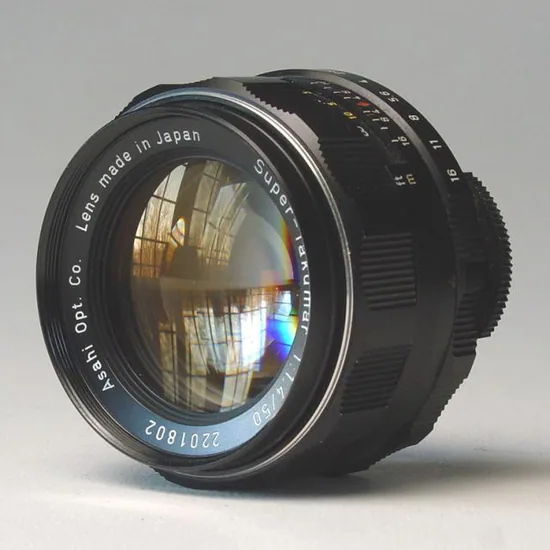
The Pentax Super-Takumar 50mm ƒ/1.4 (8-Element) Photography Lens with M42-Mount is a standard prime introduced in the 1960s. A standard field of view sits near natural perspective, the neutral choice for street, documentary and general coverage. The ƒ/1.4 maximum aperture is very fast for glass of this age, giving shallow depth of field and workable exposure in low light, closing down to ƒ/16. The lens renders softly at its widest apertures by design rather than by fault, and sharpens as it is stopped down. The lens renders with less contrast than a modern design. Its single-coated elements control internal reflection less than modern multi-coating does, so flare builds readily against a strong light source. The Pentax Super-Takumar 50mm ƒ/1.4 (8-Element) is a full-frame lens native to the M42-Mount system.
Features
Key Features
Low-Contrast, Flary Rendering
The lens renders with less contrast than a modern design, and flares readily against a light source.
ƒ/1.4 Maximum Aperture
The ƒ/1.4 maximum aperture is very fast for glass of this age, giving shallow depth of field and workable exposure in low light, closing down to ƒ/16.
Introduced in the 1960s
The lens dates from the 1960s, which sets what its coatings, its aperture mechanism and its optical design were capable of at the time.
Optical Design
6-Blade Diaphragm
6 blades set the shape of the iris, which is what out-of-focus highlights take their form from when the lens is stopped down.
Focus & Handling
45 cm Minimum Focus
Mount & Build
M42-Mount
The Super-Takumar 50mm ƒ/1.4 (8-Element) is native to the M42-Mount system, which sets what it fits directly and what it reaches through an adapter.