
Sony VENICE 2 Full-Frame 6K Digital Motion Picture Camera with E & PL Mount
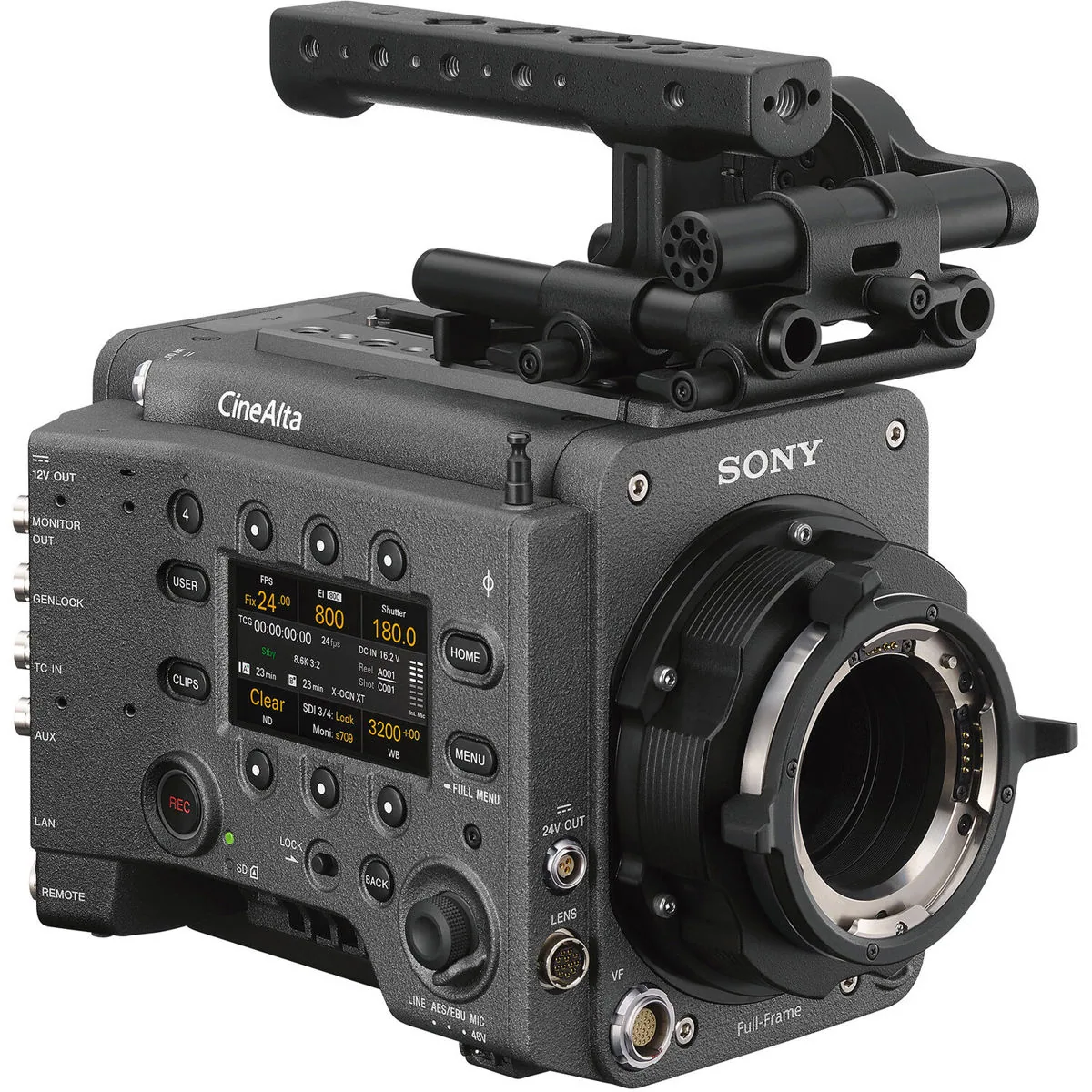
Price not listed
Key Features
- Full Frame CMOS
- S-LOG 3
- Up to 110 fps
- Internal X-OCN
- E-Mount and PL-Mount
🔒 Log in to add this to a kit.
In the Box
- 1 × Documentation
- 1 × E-mount (lever lock) adapter
- 1 × E-mount body cap
- 1 × Image sensor block (8K or 6K per SKU)
- 1 × PL lens mount
- 1 × PL mount cap
- 1 × VENICE 2 Camera Body
Colorist
Professional Color Profiles3
HLG / Rec.2020
Industry Standard10 stops10-bit recommendedHDRBroadcastQuick TurnaroundStreaming DeliveryHybrid Log-Gamma on the BT.2020 container, the pairing ITU-R BT.2100 defines for broadcast HDR. HLG is scene-referred and display-independent, so a single signal renders acceptably on both SDR and HDR displays without a separate SDR master — which is why it is the usual choice for live work where the viewer's display cannot be assumed. This is the standard HLG pairing; the BT.709-container variant exists because some cameras allow the narrower container with the same curve.
Curve: HLG2015
Hybrid Log-Gamma, developed jointly by the BBC and NHK and standardized in ITU-R BT.2100. It follows a conventional gamma curve through shadows and midtones and switches to logarithmic encoding only in the highlights, which is where the name comes from. That hybrid shape is what lets a single signal render acceptably on both SDR and HDR displays without a separate SDR master. It is scene-referred and display-independent, unlike PQ, which makes it the practical choice for live broadcast where the viewer's display cannot be assumed.
Gamut: Rec.2020Industry Standard · 2012
Defined in ITU-R BT.2020 in 2012 for ultra-high-definition television; BT.2100 later reused the same primaries for HDR. All three primaries sit on the spectral locus — they are monochromatic — which makes it the widest gamut definable without imaginary coordinates, covering 1.89 times the area of Rec.709. It is a delivery container rather than a capture space. No current display reproduces it in full, so HDR work is typically monitored on a P3 subset and delivered inside a 2020 container.
LUTs & References1
Sony S-LOG 3 / S-Gamut 3
Manufacturer Default14 stops10-bit recommendedHDRCinemaVFXStreaming DeliverySony's S-Log3 pairing for archival and ACES work, which Sony recommends for ACES recording as 10-bit MXF. S-Gamut3 shares S-Gamut's primaries exactly — Sony's technical summary prints the two as a single row — so this pairing widens the curve rather than the container relative to the S-Log2 generation. It differs from the S-Gamut3.Cine pairing in the shape of the container, not meaningfully in its size.
Curve: S-LOG 32014
Introduced in 2014 alongside S-Gamut3 and S-Gamut3.Cine, based on the Cineon digital-negative curve as revised in 2007. It has no highlight shoulder — the log section runs straight to the top — which is what separates it from S-Log2 and gives it about 1.5 stops more range. It places 18% gray at 0.4106, or 10-bit code 420, with 7.7 stops of headroom above it. Sony records it as full range in XAVC and MPEG, so material read as legal range will show wrong contrast before any grading begins.
Gamut: S-Gamut 3Proprietary · 2014
Introduced in 2014 alongside S-Log3. It shares S-Gamut's primaries exactly — Sony's own technical summary prints the two as a single row — so its area is identical at 2.49 times Rec.709. What changed between the generations was the transfer function, not the gamut. Sony recommends it for ACES and for archival recording, where the wide container is an advantage; for hand grading it carries the same caveat as S-Gamut.
LUTs & References7
Sony S-LOG 3 / S-Gamut 3.Cine
Manufacturer Default14 stops10-bit recommendedHDRCinemaTheatrical DeliveryVFXSony's grading-oriented S-Log3 pairing, released alongside the S-Gamut3 version. The two containers are within one per cent in area; what separates them is shape — S-Gamut3.Cine pulls its green primary well in toward realisable color, which makes it behave predictably under a grade where S-Gamut3's extreme green does not. Sony describes it as suited to DCI-P3 grading, which is where the pairing is most often used.
Curve: S-LOG 32014
Introduced in 2014 alongside S-Gamut3 and S-Gamut3.Cine, based on the Cineon digital-negative curve as revised in 2007. It has no highlight shoulder — the log section runs straight to the top — which is what separates it from S-Log2 and gives it about 1.5 stops more range. It places 18% gray at 0.4106, or 10-bit code 420, with 7.7 stops of headroom above it. Sony records it as full range in XAVC and MPEG, so material read as legal range will show wrong contrast before any grading begins.
Gamut: S-Gamut 3.CineProprietary · 2014
Released with S-Gamut3 as the grading-oriented member of the pair. The difference between them is shape rather than size: the two are within one per cent in area (2.46 against 2.49 times Rec.709), but S-Gamut3.Cine pulls its green primary in from 0.140, 0.855 to 0.225, 0.800, much closer to realisable color, while extending its red. Sony describes it as suited to DCI-P3 grading. That tamer green is what makes it predictable under a grade where S-Gamut3's extreme green is not.
LUTs & References7