
Leitz M 0.8 21mm ƒ/1.4 Cinema Lens with M-Mount
Overview
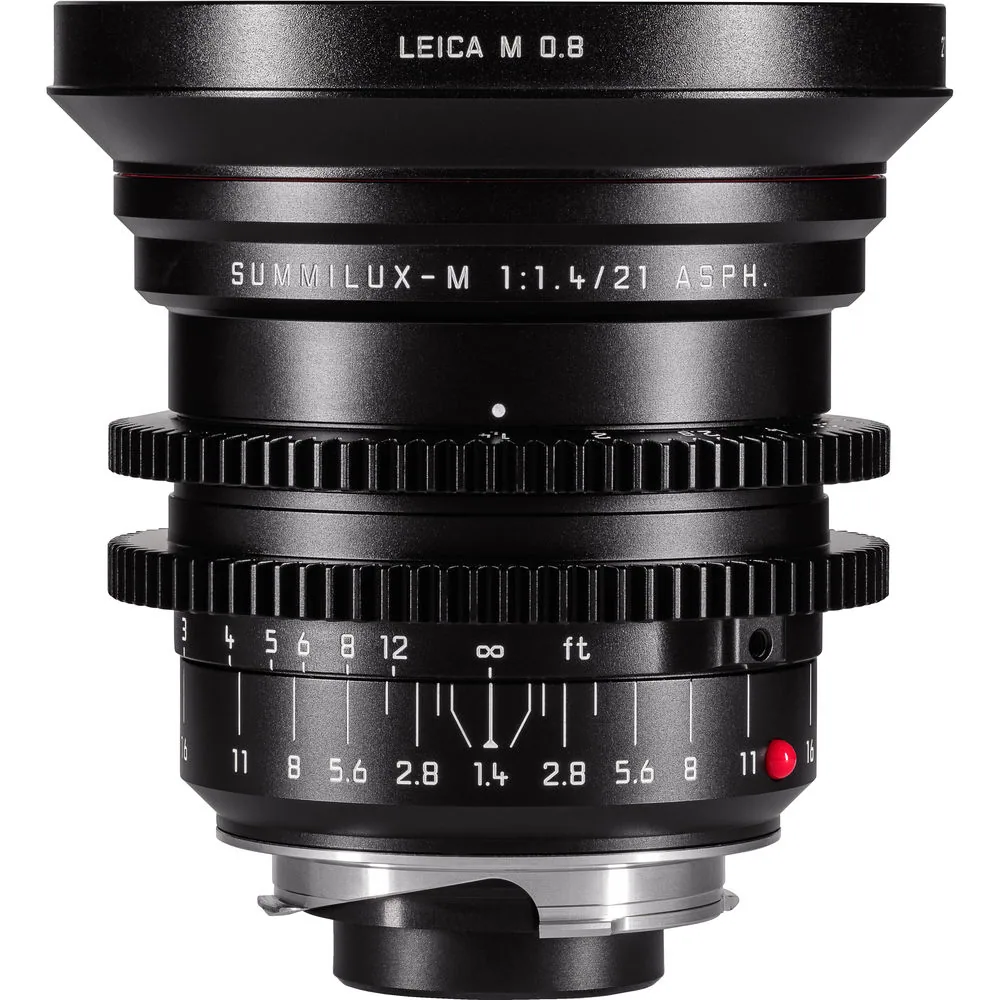
The Leitz M 0.8 21mm ƒ/1.4 Cinema Lens with M-Mount is an ultra-wide spherical prime that covers Full Frame sensors. Ultra-wide coverage takes in a full setting from a short distance, which suits establishing shots, tight interiors, and vehicle work where the camera cannot be moved back. A ƒ/1.4 maximum aperture puts this among the fastest cine glass available, giving very shallow depth of field and workable exposure in low light. It uses an M-Mount with manual focus. The focus barrel is marked in both feet and meters.
Features
Key Features
Ultra-Wide Full Frame Coverage
The lens covers Full Frame sensors, projecting a 43.3 mm image circle. An ultra-wide field of view keeps interiors, vehicle mounts, and establishing shots workable from close in, where there is no room to move the camera back.
ƒ/1.4 Maximum Aperture
ƒ/1.4 puts this among the fastest cine glass available. Depth of field wide open is measured in inches at close range, which demands an experienced focus puller and rewards one with separation no slower lens produces.
Dual-Marked Focus Scale
The barrel carries both feet and meters, letting the lens drop into either workflow without anyone converting figures at the cart.
Focus & Handling
70 cm Minimum Focus
Mount & Rig Integration
0.8-Pitch Cine Gears
The lens carries 0.8-pitch cine gears, the standard pitch for follow focus units and lens motors. Compatibility with lens control systems lets a solo operator make consistent, repeatable focus pulls, or a camera assistant control the lens remotely.
80mm Front Diameter
The front element measures 80mm, which fits a compact matte box directly and steps up to a 114 mm clamp with an adapter ring. Matte box fit follows from this measurement rather than from the filter thread, since the clamp grips the outside of the barrel.
77mm Filter Thread
The front accepts 77mm screw-in filters behind an 80mm front element. A matte box clamps to the outside diameter instead, which is what most cine setups use to avoid re-threading filters between lenses.